If you’ve started researching CBT vs. ERP for OCD, the two terms probably look like rivals. They aren’t, quite, and the difference matters for your recovery. ERP is a specific form of CBT, and it has the strongest research behind it for obsessive-compulsive disorder. This guide explains how the two relate, what each looks like in a session, and how to pick the best therapy for OCD for you, so you can walk into a first appointment with clear questions and realistic expectations.
What Are the Signs of OCD, and How Is It Different From Anxiety?
The classic signs of OCD are unwanted, repetitive thoughts (obsessions) and rituals you feel driven to perform (compulsions), such as repeated checking, excessive handwashing or counting.
OCD vs anxiety is a common question. Everyday worry centres on real-life concerns and fades with problem-solving. OCD involves obsessive thoughts and compulsive behaviours that feel uncontrollable and make little logical sense, even to you. That distinction matters because exposure therapy for anxiety in general differs from ERP, which is built around resisting rituals.
What’s the Real Difference Between CBT and ERP for OCD?
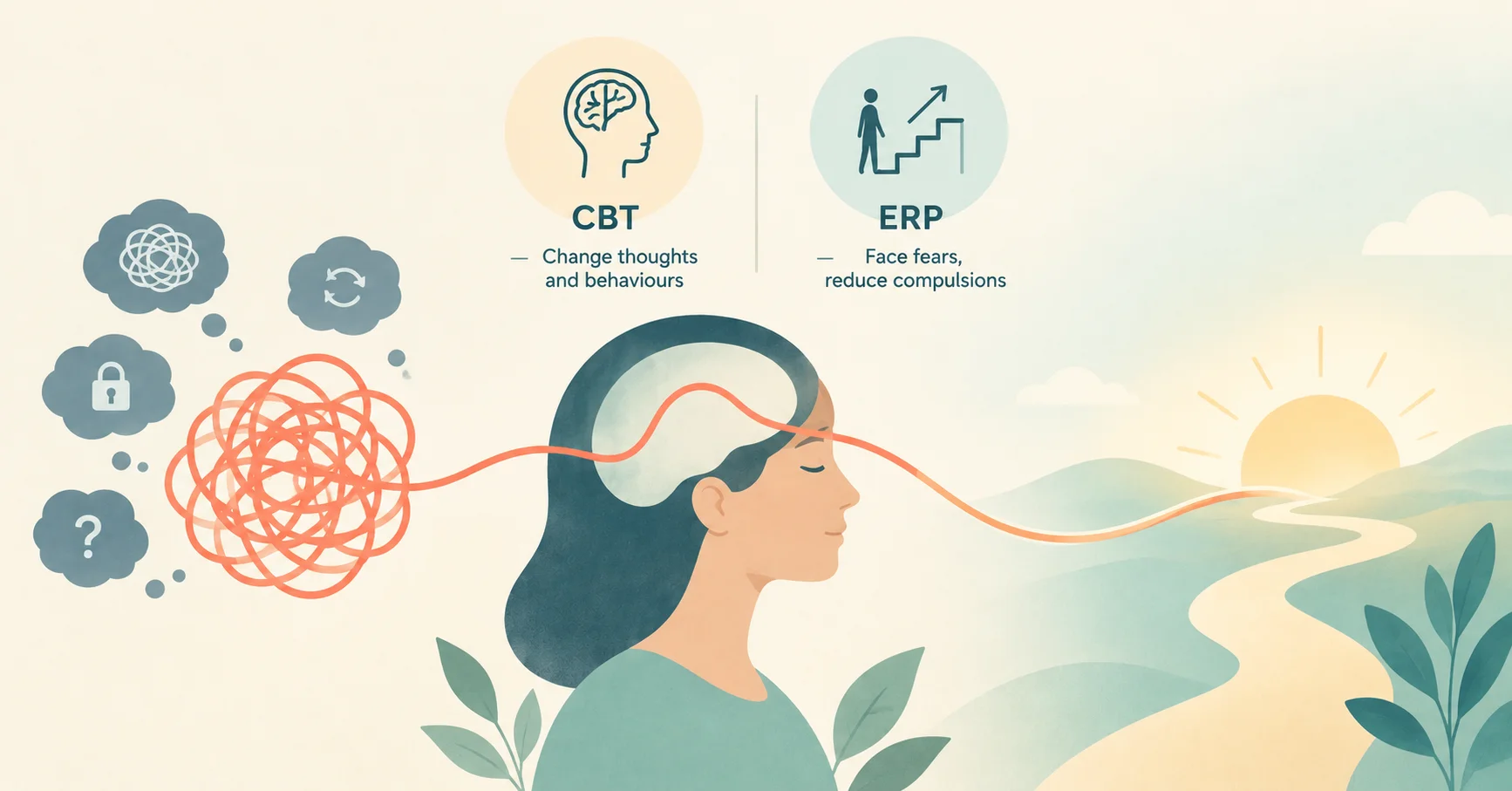
CBT is a broad family of therapies linking thoughts, feelings, and behaviour. ERP (exposure and response prevention) is one technique within it, built around facing fears while resisting compulsions.
- General CBT challenges distorted beliefs, such as “If I have this thought, I’m dangerous.”
- ERP uses behavioural experiments: you approach a trigger and choose not to perform the ritual.
Both change how you respond to intrusive thoughts. They just pull different levers.
Is ERP Actually a Type of CBT, or a Separate Treatment?
ERP is a type of CBT. Research papers routinely describe it as a form of cognitive behavioral therapy and as the main psychological treatment for OCD across children, teens, and adults.
A clinic advertising “CBT for OCD” might mean ERP, or talk-based work with little exposure. Ask directly.
Which Therapy Works Better: CBT or ERP for Obsessive-Compulsive Disorder?
ERP has the edge. A 2021 meta-analysis found that strict ERP protocols reduced OCD symptoms more than both neutral and active comparison treatments, and the authors concluded ERP should be recommended as an optimal therapy.
Cognitive techniques still help people who struggle to start exposure. But on evidence, ERP wins.
Why Do Experts Call ERP the Gold Standard for OCD?
ERP is called the gold standard treatment for OCD because it’s backed by decades of trials and recommended as first-line psychotherapy in clinical guidance. Reviews note that its effectiveness is comparable to that of SSRIs, the first-line medications.
It also targets the engine of the disorder. Compulsions bring short-term relief, which teaches your brain the obsession was a real threat. ERP breaks that loop by letting anxiety rise and fall without a ritual.
How Does ERP Therapy Actually Work?
ERP works by gradually exposing you to triggers while you resist compulsions, until the trigger loses its power. It is structured, collaborative, and paced by you.
A typical course looks like this:
- Assessment. Your therapist maps your obsessions, compulsions, and avoidance patterns.
- Fear hierarchy. Together you rank triggers from mildly uncomfortable to terrifying.
- Graded exposure. You start low, say touching a doorknob, and work upward.
- Response prevention. You hold off on washing, checking, reassurance seeking in OCD (asking others, “are you sure it’s fine?”), or mental rituals.
- Homework. Practice between sessions is where much of the progress happens.
For example, someone with contamination fears might touch a public surface, then wait 30 minutes before washing. The first time feels awful; by the fifth it’s duller.
What Happens During a Typical CBT Session for OCD?
A CBT session for OCD combines education, thought work, and some behavioural practice, usually weekly for 45 to 60 minutes. If your therapist never moves toward facing triggers, you’re likely getting cognitive-only therapy rather than ERP.
Can CBT Treat OCD Without Exposure Exercises?
It can help some people, but results are generally stronger with exposure. If months of talk therapy haven’t budged your rituals, ask about ERP.
How Long Does It Take to See Results With CBT vs ERP?
Many people begin noticing change within the first couple of months of consistent ERP, and a full course commonly runs around 12 to 20 weekly sessions. Severe or long-standing OCD may need longer or more intensive formats.
Timelines vary with severity and how often you practise. Starting early matters, since treatment gets harder the longer symptoms go untreated (Mao et al., 2022). Good care also includes OCD relapse prevention: a plan for what to do if symptoms flare during stress.
Is One Therapy More Distressing Than the Other?
ERP feels harder in the moment, but fear that it drives people away is largely unfounded. A meta-analysis of youth trials found that attrition and efficacy data gave little justification for clinicians to withhold ERP.
A good therapist never throws you in at the deep end; you set the pace.
Which Therapy Is Better for Specific OCD Subtypes?
ERP can be adapted to nearly every subtype, including contamination, checking, harm obsessions, and pure O OCD, where compulsions are mostly mental. Therapists also adapt it for OCD in children and teenagers, often involving parents in the process.
- Contamination or checking: classic in-vivo exposure works well.
- Intrusive harm or taboo thoughts: imaginal exposure (scripts or recordings) is often used.
- Mental compulsions: therapists target covert rituals, like mentally reviewing or “neutralising” a thought.
How Can You Stop Intrusive Thoughts Between Sessions?
You can’t force a thought to vanish; trying usually makes it louder. Better self-help for OCD is to change your response:
- Label it: “That’s an OCD thought,” not “That’s a fact.”
- Note your OCD triggers (places, news, stress, tiredness) so you can plan for them.
- Delay the ritual by a few minutes, then a few more. This is the heart of how to stop compulsions.
- Skip the reassurance from family, search engines or checking apps.
These habits support therapy but don’t replace it. If you’re searching for how to stop intrusive thoughts because they feel relentless, see an ERP-trained therapist.
Should You Combine CBT and ERP for Better Results?
Often you already do. ERP-based therapy typically includes cognitive elements like psychoeducation, with ERP doing the heavy lifting.
Do You Need Medication Along With Therapy?
Not always, but it can help. SSRIs such as fluoxetine, sertraline, paroxetine, and fluvoxamine are first-line medications for OCD. A meta-analysis of 21 trials found that ERP plus medication outperformed medication alone, with better maintenance at follow-up.
Mild to moderate OCD often responds to therapy alone. Severe symptoms, co-occurring OCD and depression, or anxiety too overwhelming for exposure are common reasons to add medication. A psychiatrist can guide that decision.
How Do You Choose the Right Therapist for OCD?
Look for someone with specific training in ERP, not just general anxiety experience. Ask these questions in a first call:
- Do you use exposure and response prevention, and how often?
- How do you handle reassurance-seeking and mental compulsions?
- Will I get homework and a clear treatment plan?
- How will we track progress, for example with the Y-BOCS scale?
Online therapy for OCD is a practical option too. ERP translates well to video sessions, since many exposures happen in your own home, and online counselling for OCD can give you access to specialists you couldn’t reach locally.
Red flags include a therapist who only offers reassurance, avoids exposure entirely, or promises to erase intrusive thoughts. The realistic goal is that thoughts stop controlling your behaviour.
Quick Answers to Common Questions
What is the best therapy for OCD?
ERP, a form of CBT, has the strongest evidence and is first-line.
Does ERP work without medication?
Often yes, especially for mild to moderate OCD, though some people benefit from both.
How do I stop intrusive thoughts?
Treat them as noise rather than fact, avoid rituals and reassurance, and work with an ERP-trained therapist.
Is OCD just anxiety?
No. It’s a distinct condition involving obsessions and compulsions, though anxiety is often part of it.
Can ERP be done online?
Yes, many therapists deliver ERP by video, including home-based exposure exercises.
Conclusion
The ERP vs CBT OCD treatment debate mostly dissolves once you see that ERP is CBT’s most effective tool for OCD. Choose an ERP-trained therapist, expect some discomfort, and judge progress by how much less your rituals run your day.
If you’re ready to take the first step, TalktoAngel connects you with experienced mental health professionals who can assess your symptoms and help you build a personalised OCD treatment plan, including online counselling if that suits you better. Reaching out is the hardest part.
References
- Ferrando, C., & Selai, C. (2021). A systematic review and meta-analysis on the effectiveness of exposure and response prevention therapy in the treatment of obsessive-compulsive disorder. UCL Discovery. https://discovery-pp.ucl.ac.uk/id/eprint/10135430
- Johnco, C., McGuire, J. F., Roper, T., & Storch, E. A. (2014). A meta-analysis of dropout rates from exposure with response prevention and pharmacological treatment for youth with obsessive-compulsive disorder. Macquarie University research output. https://researchers.mq.edu.au/en/publications/a-meta-analysis-of-dropout-rates-from-exposure-with-response-prev/
- Mao, L., Hu, M., Luo, L., Wu, Y., Lu, Z., & Zou, J. (2022). The effectiveness of exposure and response prevention combined with pharmacotherapy for obsessive-compulsive disorder: A systematic review and meta-analysis. Frontiers in Psychiatry, 13. https://doi.org/10.3389/fpsyt.2022.973838
- The efficacy and neural correlates of ERP-based therapy for OCD & TS: A systematic review and meta-analysis. (2022). Journal of Integrative Neuroscience, 21(3). https://doi.org/10.31083/j.jin2103097
- American Psychiatric Association. (2007). Practice guideline for the treatment of patients with obsessive-compulsive disorder.
- National Institute for Health and Care Excellence. Obsessive-compulsive disorder and body dysmorphic disorder: treatment (CG31).
- International OCD Foundation. About OCD and ERP treatment. iocdf.org