
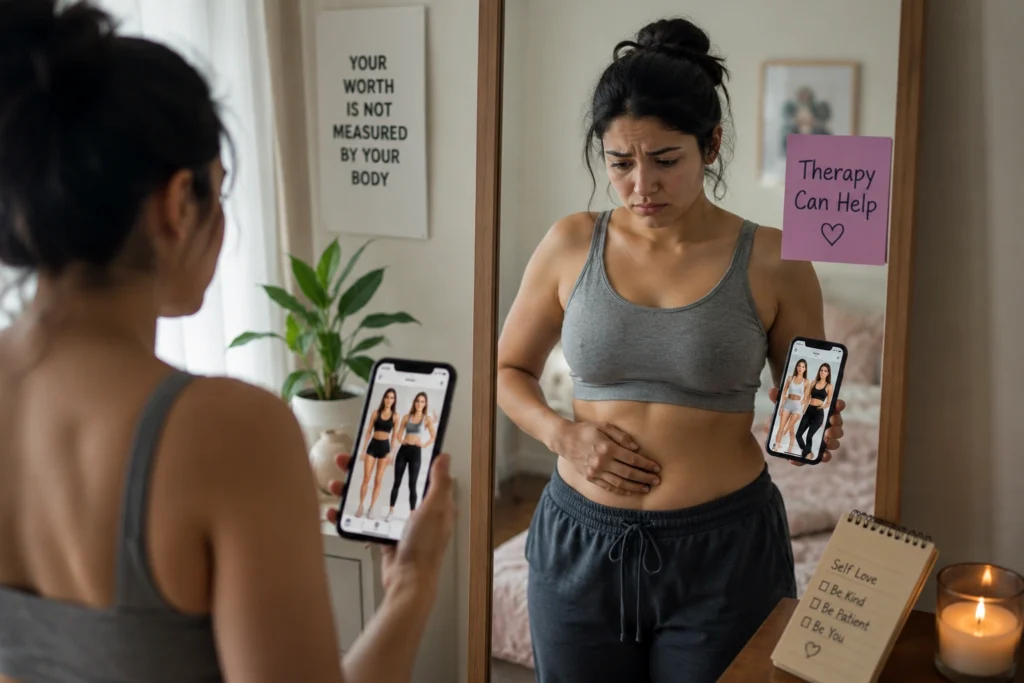
Why You Can’t Stop Comparing Your Body to Others: How Therapy Can Help
Scrolling through your phone, catching a reflection in a store window, trying on clothes in a fitting room—suddenly you’re measuring yourself against someone else’s body. If this sounds familiar, you’re not alone, and you’re definitely not “vain” or “shallow” for feeling this way. Body comparison is one of the most common struggles people bring into therapy today. The good news? Understanding why it happens is the first step toward loosening its grip, and online therapy for body image issues offers real, practical tools to help you get there.
Why Do We Compare Our Bodies to Others in the First Place?
Comparison is a wired-in human behavior, not a personal flaw. Psychologists call it “social comparison theory”—we naturally look to others to figure out where we stand.
A few reasons this shows up so strongly around appearance:
- Evolutionary wiring: Humans have always sized each other up as a way of gauging status and belonging.
- Cultural messaging: From childhood, many of us absorb the idea that appearance determines worth.
- Uncertainty: When we feel insecure about ourselves, we look outward for a benchmark, even if it hurts.
Comparison itself isn’t the enemy. The problem starts when it becomes constant, harsh, and tied to your self-esteem.
Is Body Comparison a Sign of a Deeper Mental Health Issue?
Not always—but sometimes, yes. Occasional comparison is normal. Persistent, distressing comparison that affects your mood, relationships, or daily functioning can point to something that deserves attention.
It may be worth exploring with a professional if you notice:
- You avoid social situations, photos, or mirrors because of how you think you look.
- Comparison thoughts feel intrusive and hard to switch off.
- Your mood swings dramatically based on how you feel about your appearance that day.
- You’ve developed rigid rules around eating, exercise, or grooming tied to appearance anxiety.
If these patterns feel familiar, that’s not something to push through alone. A therapist can help you understand whether what you’re experiencing is general body dissatisfaction, anxiety, or something that needs more targeted support.
How Does Social Media Fuel Body Comparison and Insecurity?
Social media didn’t invent body comparison, but it has supercharged it. Feeds are curated highlight reels, filtered and angled, yet our brains often process them as “normal.”
Here’s what tends to happen:
- Constant exposure: You see dozens of bodies daily, far more than in pre-digital life, which increases comparison opportunities.
- Algorithmic reinforcement: The more you engage with certain content, the more similar content you’re shown, deepening fixation.
- Blurred reality: Filters and editing tools make “unrealistic” look “normal,” shifting your internal baseline.
A simple, practical starting point is auditing your feed. Notice which accounts leave you feeling worse after scrolling, and consider muting or unfollowing them. It won’t solve everything, but it reduces the noise your mind has to fight against.
What’s the Difference Between Normal Comparison and Body Dysmorphia?
A typical body comparison is irregular, situational, and doesn’t take up much of your day. You might notice someone’s physique at the gym and move on with your life.
Body dysmorphia (clinically known as Body Dysmorphic Disorder, or BDD) is different. It involves:
- Obsessive focus on a perceived flaw, often one others barely notice.
- Repetitive behaviors like mirror-checking, skin-picking, or excessive grooming.
- Significant distress or time lost fixating on appearance.
- Avoidance of daily activities because of appearance-related shame.
BDD is a recognized mental health condition, not just “bad body image,” and it typically requires professional treatment. If this sounds like what you’re experiencing, talking to a licensed therapist is a meaningful next step rather than something to self-diagnose.
How Does Body Comparison Affect Self-Esteem Over Time?
Left unaddressed, chronic body comparison can quietly reshape how you see yourself, well beyond appearance.
Over time, it can contribute to:
- Lower self-esteem, because your sense of worth becomes tied to an ever-shifting external standard.
- Increased anxiety and low mood, since comparison often triggers a cycle of self-criticism.
- Strained relationships, if comparison leads to jealousy, withdrawal, or reassurance-seeking.
- Disrupted daily life, when appearance worries start dictating what you wear, eat, or where you go.
The pattern tends to reinforce itself. The more you compare, the more your brain treats appearance as the measure that matters most, keeping the cycle going.
What Does Online Therapy Actually Do to Help With Body Image?
Therapy isn’t about telling you to “just love yourself.” It’s about rewiring underlying thought patterns and building real, lasting body confidence.
Here’s what that process typically looks like:
- Identifying the pattern: A therapist helps you notice when, where, and why comparison spikes for you specifically.
- Challenging distorted thoughts: You learn to spot distortions (like “everyone is judging me”) and test them against reality.
- Building coping tools: Practical strategies replace the comparison spiral, ones you can use in the moment.
- Addressing root causes: Body image struggles often connect to earlier experiences or family messaging, which therapy can help unpack safely.
- Tracking progress: Small shifts, like fewer mirror checks or less time spent comparing, build genuine momentum.
Online therapy for body image issues makes this process more accessible. You can talk to a therapist about body image from home, on a schedule that fits your life.
Which Therapy Approaches Work Best for Body Image Issues?
- Cognitive Behavioral Therapy (CBT): Widely used to overcome body dissatisfaction by reshaping negative thought patterns.
- Acceptance and Commitment Therapy (ACT): Focuses on accepting difficult thoughts while still living according to your values.
- Mirror exposure therapy: A structured technique, often used for BDD, that gradually reduces avoidance and distress.
- Compassion-Focused Therapy (CFT): Helps build self-esteem by replacing harsh self-criticism with a supportive internal voice.
- Group therapy: Offers shared experience and reduces the isolation that comes with appearance-related shame.
There’s no single “correct” approach. A therapist will tailor the plan to your specific triggers and goals.
Frequently Asked Questions
How do I stop comparing my body to others?
Start by noticing your triggers, specific apps, people, or situations that spark comparison, and limiting exposure where you can. Pair this with reframing techniques from CBT, which help you challenge automatic negative thoughts rather than accept them as fact. If comparison feels constant or distressing, working with a therapist gives you a structured, personalized way to break the cycle rather than relying on willpower alone.
Can therapy really help with body image issues, or is it just about mindset?
Therapy goes well beyond “positive thinking.” Evidence-based approaches like CBT and ACT address the root thought patterns and behaviors driving body dissatisfaction, not just surface-level mindset. Many people notice measurable changes, like reduced mirror-checking or less time spent scrolling comparison-triggering content, within a matter of weeks of consistent sessions.
Is it normal to compare my body to others on social media every day?
Occasional comparison is common and doesn’t necessarily signal a problem. However, if daily scrolling consistently leaves you feeling worse about yourself, affects your mood, or shapes decisions about eating, exercise, or socializing, it’s worth addressing. A therapist can help you determine whether this is a manageable habit or something that needs deeper support.
Moving Forward, One Step at a Time
Comparing your body to others doesn’t make you superficial. It makes you human, shaped by biology, culture, and a media landscape built to keep you looking. But when comparison starts running your life, that’s a signal worth listening to, not ignoring. If these feelings run deeper and you find yourself asking, Why Do I Hate the Way I Look?, that’s worth exploring further too.
You don’t have to figure this out alone. Therapy offers a structured, judgment-free space to build a genuinely healthier relationship with your body.
Connect with top psychologists & therapists online today, and take the first step toward a more confident, self-assured you.