
Every marriage hits rough patches — the question is whether couples know how to work through them. Most common marriage problems fall into a handful of predictable categories: communication breakdowns, trust issues, money stress, fading intimacy, and constant arguing. None of these mean your relationship is beyond repair; though left unaddressed, they can take a real toll — research increasingly links the impact of unresolved conflict on mental health to higher stress, poor sleep, and lower overall wellbeing for both partners. With the right marriage counseling, each of these problems has a practical, proven path forward. Here’s what causes them and how a counselor actually helps.
What Are the Most Common Problems Couples Face in Marriage?
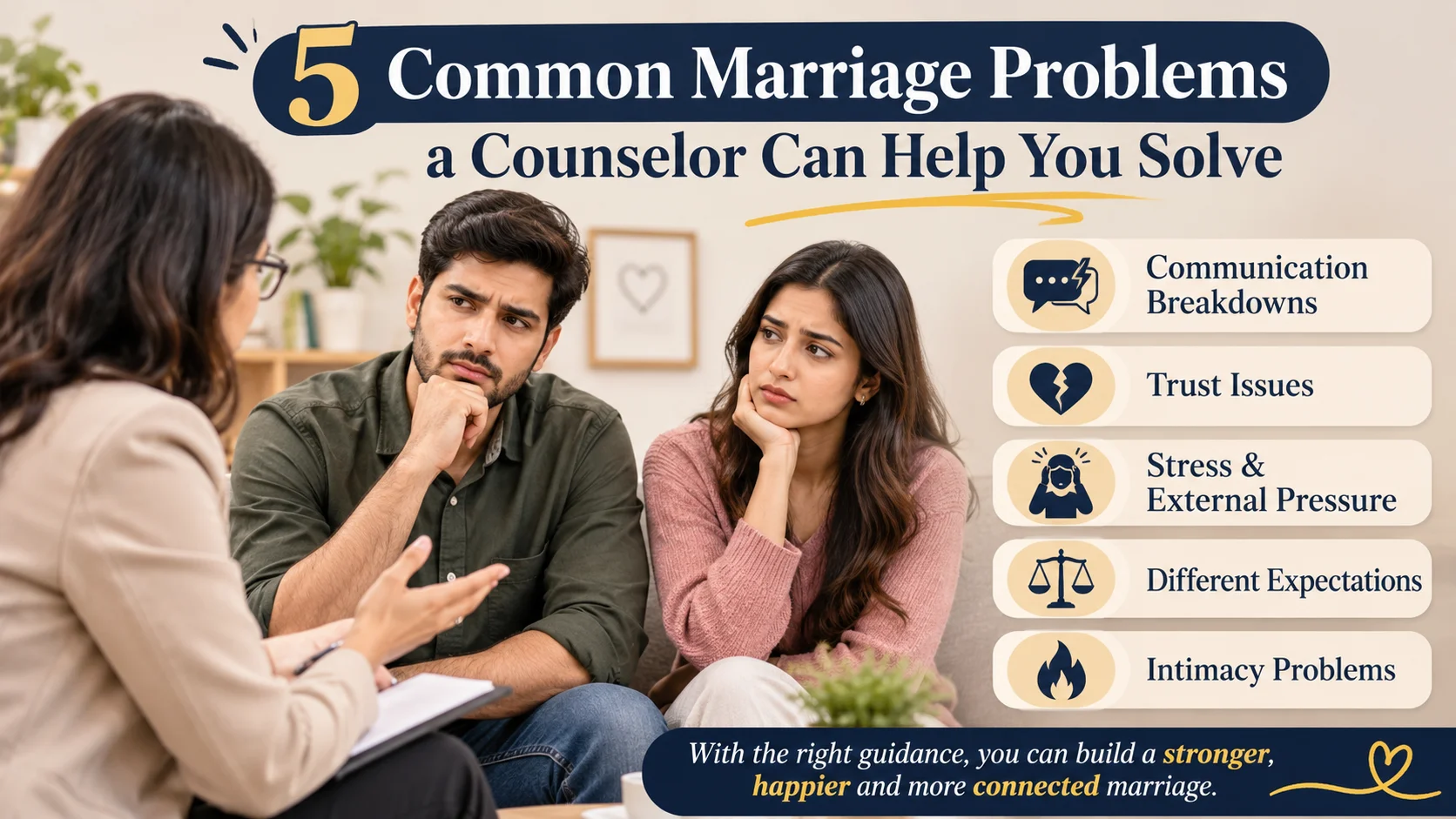
While every relationship is different, therapists repeatedly see the same five issues drive couples into their offices:
- Communication problems in marriage — talking past each other instead of to each other
- Trust issues in marriage — from small broken promises to infidelity
- Financial problems in marriage — mismatched spending habits or secrecy around money
- Intimacy issues in marriage — emotional distance that spills into the physical relationship
- Chronic, unresolved conflict that resurfaces in every argument, regardless of the topic
Recognizing which of these marriage problems and solutions apply to your relationship is the first step toward actually fixing them.
Why Does Communication Break Down Between Spouses?
Communication rarely fails because couples stop talking — it fails because they stop listening. Over time, partners fall into patterns of criticism, defensiveness, or complete shutdown during disagreements.
Dr. John Gottman’s long-running research on couples identifies four communication patterns — criticism, contempt, defensiveness, and stonewalling — that predict relationship breakdown with striking accuracy. A counselor trained in approaches like the Gottman Method helps couples replace these habits with structured listening exercises, so conversations stop escalating into blame and start resolving the actual issue. Left unaddressed, this pattern is also a common driver of relationship anxiety and emotional exhaustion, which is why learning better communication skills matters for mental health, not just for the marriage itself.
How Does Trust Get Damaged in a Marriage — And Can It Be Rebuilt?
Trust erodes through both dramatic events, like infidelity, and quieter ones — broken promises, financial secrecy, or dishonesty about small things that pile up over years. Once broken, trust doesn’t repair itself through time alone; it needs a deliberate process.
Rebuilding trust after infidelity in marriage typically involves three stages: full transparency from the partner who broke trust, consistent and verifiable follow-through over time, and space for the hurt partner to process their emotions without being rushed. A counselor acts as a neutral guide through all three stages, which is difficult for couples to navigate alone. Broken trust also tends to bring symptoms of anxiety and hypervigilance in relationships, so addressing the emotional fallout alongside the practical rebuilding work is just as important.
Why Do Financial Disagreements Cause So Much Marital Stress?
Money fights are rarely just about money — they’re usually about control, security, or differing values inherited from each partner’s upbringing. Financial problems in marriage often surface as disagreements over spending, saving, debt, or financial transparency between partners.
A counselor doesn’t replace a financial planner, but helps couples talk about money without the conversation turning into a power struggle. Many therapists use techniques borrowed from cognitive behavioral therapy for couples to identify the underlying beliefs — like “spending equals freedom” or “saving equals safety” — that fuel recurring money arguments. Because chronic money stress is also one of the most common causes of financial stress and anxiety, working through it in counseling often improves both the relationship and each partner’s individual wellbeing.
What Causes Emotional and Physical Intimacy to Fade Over Time?
Intimacy issues in marriage usually build gradually: stress, parenting demands, unresolved resentment, or simply drifting into routine can quietly replace closeness with distance. Physical intimacy often fades first because emotional intimacy already has.
Counseling helps couples rebuild connection in small, consistent ways — scheduled time together, honest conversations about needs, and exercises that rebuild emotional safety before physical closeness is expected to follow. Fading intimacy is also closely tied to loneliness in marriage and its effect on mental health, so reconnecting emotionally often lifts mood and reduces stress for both partners, not just the relationship.
How Does Constant Arguing Affect a Marriage Long-Term?
Occasional conflict is normal and even healthy in a marriage. But when the same arguments repeat without resolution, couples start to associate each other with frustration rather than support, which quietly damages the relationship’s foundation.
A counselor helps couples identify the real issue underneath repetitive arguments — often a need that isn’t being met — rather than letting the surface-level disagreement replay on a loop. Living in a high-conflict home over time is also linked to chronic stress and its long-term health effects, which is one more reason to address recurring arguments sooner rather than later.
How Can a Marriage Counselor Help You Solve These Problems?
A trained counselor brings three things most couples can’t provide for each other mid-argument: neutrality, structure, and tools backed by research. Rather than taking sides, a counselor helps both partners understand each other’s perspective and teaches cognitive behavioral therapy for couples techniques to interrupt unhelpful patterns before they escalate.
Counselors also customize their approach to the specific problem — communication-focused exercises for couples stuck in conflict, trauma-informed techniques for rebuilding trust after infidelity, or structured financial conversations for money-related stress.
What Does a Typical Marriage Counseling Session Look Like?
Most marriage counseling sessions run 45–60 minutes and begin with each partner sharing their perspective on a current issue. The counselor then guides the conversation using structured techniques — reflective listening, role-reversal exercises, or identifying thought patterns from cognitive behavioral therapy for couples.
Sessions are collaborative, not confrontational. A good counselor keeps the focus on solutions and skill-building rather than relitigating old arguments, and most couples notice shifts in how they communicate within a handful of sessions.
How Do You Know It’s Time to See a Marriage Counselor?
You don’t need to wait for a crisis. Consider reaching out to a counselor if you notice any of the following:
- The same argument keeps resurfacing without resolution
- One or both partners feel unheard or criticized often
- Trust has been broken and hasn’t been rebuilt
- Physical or emotional intimacy has noticeably declined
- You’re avoiding each other instead of addressing problems
Couples who seek support early, rather than after years of accumulated resentment, generally find it easier to rebuild their connection. Noticing early warning signs of relationship burnout, such as persistent irritability or dreading time together, is often a useful signal that it’s time to reach out.
Can Marriage Counseling Actually Save a Struggling Relationship?
Yes — for many couples, counseling meaningfully improves relationship satisfaction when both partners are willing to participate. A study on the Gottman Method published in the Iranian Journal of Psychiatry found that structured couples therapy improved marital adjustment and intimacy across the study’s assessment periods. Outcomes vary by couple, but counseling consistently gives partners tools they didn’t have before — and tools make a measurable difference in how conflict gets handled.
Counseling can’t guarantee every marriage will work out, and in some cases, it helps couples separate with more clarity and less damage. But for couples still committed to the relationship, it remains one of the most effective marriage problems and solutions available.
TalktoAngel, a Trusted Online Platform for Mental Health Support
If you and your partner are ready to work through these issues, you don’t need to find time for in-person appointments or wait weeks for an opening. TalktoAngel offers affordable marriage counseling online, connecting couples with licensed, experienced therapists from the privacy of home — on a schedule that fits around work and family life.
Connect with an experienced marriage counselor online through TalktoAngel today, and take the first step toward resolving the issues that have been weighing on your marriage.
Frequently Asked Questions
What are the most common reasons couples go to marriage counseling? Communication breakdown, trust issues, financial disagreements, fading intimacy, and chronic unresolved conflict are the most common reasons couples seek counseling.
How long does marriage counseling usually take to show results? Many couples notice improved communication within the first several sessions, though rebuilding trust or resolving deeper issues typically takes longer-term, consistent work.
Is online marriage counseling as effective as in-person sessions? Research increasingly shows comparable outcomes between online and in-person couples therapy when sessions are conducted by a licensed, trained counselor.
Can one partner go to marriage counseling without the other? Yes — individual counseling can still help a person understand relationship patterns and communicate differently, though joint sessions typically produce faster results for shared issues.
What if we’ve tried counseling before and it didn’t work? A different counselor, approach, or timing can make a significant difference. It’s worth trying again, particularly with a therapist trained in structured methods like the Gottman Method or cognitive behavioral therapy for couples.
References
- 7 Principles to Make Marriage Work — Gottman Institute research on communication patterns
- Examining the Effectiveness of Gottman Couple Therapy on Improving Marital Adjustment and Couples’ Intimacy — Iranian Journal of Psychiatry (PMC)
- How Communication Skills May Help Those in a Struggling Marriage Avoid Divorce — BetterHelp