

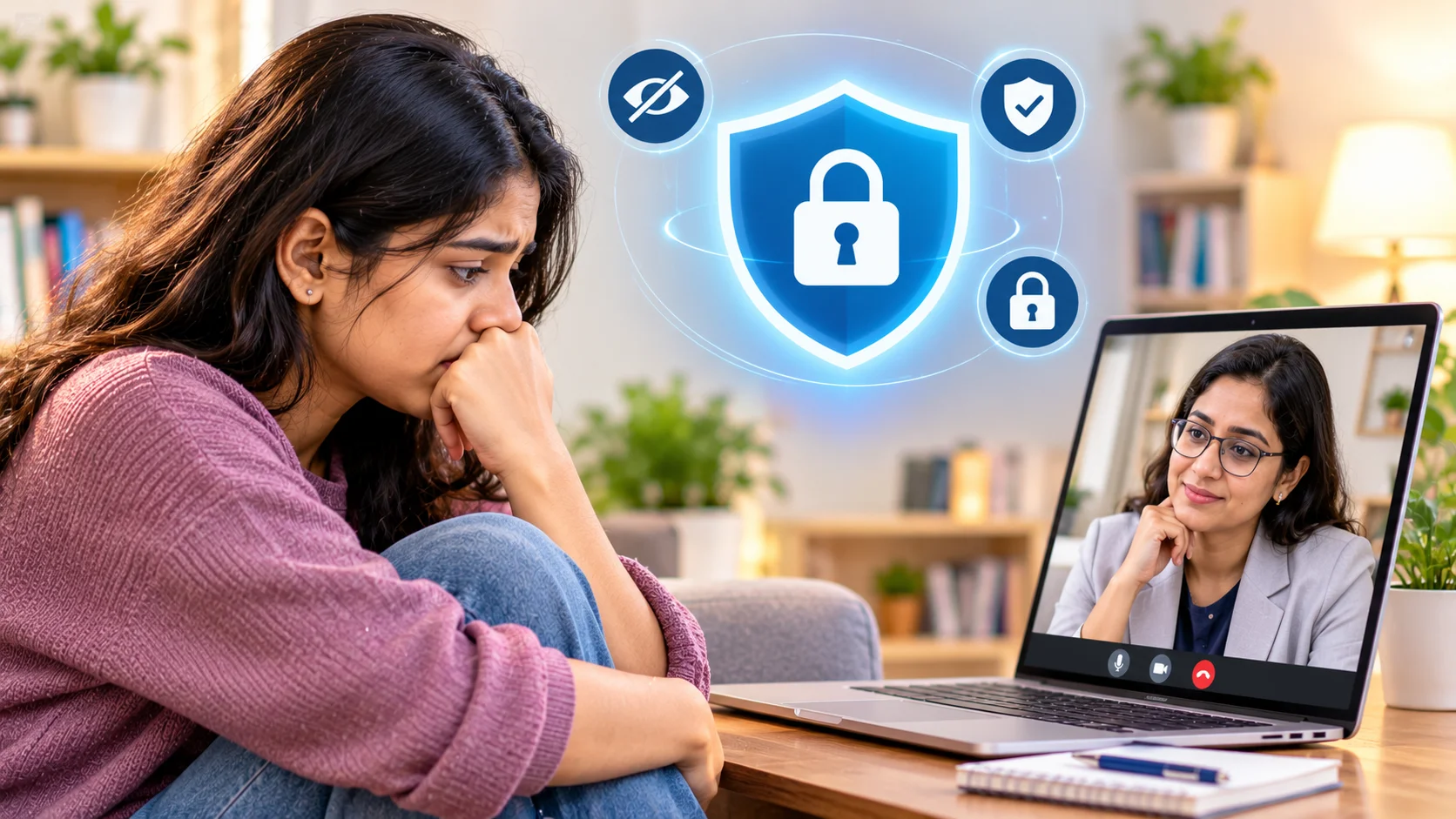
You’ve thought about talking to someone. Maybe it’s the fight that won’t stop replaying in your head, the anxiety that’s been creeping into your workday, or a grief you haven’t told anyone about. But right before you open that booking page, a different worry shows up: what if someone finds out?
That hesitation is normal, and it’s exactly why confidential online counselling exists today—built around strict privacy rules, secure technology, and a therapist’s ethical duty to protect what you share. This guide explains how confidential mental health support works online, what laws and ethics protect, and how to choose a platform you can trust with your story.
What Is Confidential Online Counselling and How Does It Work?
Confidential online counselling is therapy delivered through video calls, phone sessions, or secure messaging, where everything you share is protected under the same professional confidentiality rules that apply in a therapist’s physical office. The format changes; the ethical and legal obligations don’t.
When you sign up for online counselling for emotional support, here’s typically what happens:
- You complete an intake form, sharing basic details and the reason you’re seeking support.
- You’re matched with a licensed therapist suited to your concern (anxiety, relationship issues, grief, trauma, etc.).
- Sessions happen over an encrypted video or audio platform, or through a secure chat portal.
- Your records are stored in a protected system, accessible only to you and your treating therapist.
Reputable professional online counselling services are run by licensed psychologists and counsellors who are bound by the same codes of ethics — and often the same legal penalties for breach — as in-person practitioners.
Is Online Counselling Really Private and Secure?
Yes, when you use a legitimate, well-reviewed platform. Privacy in online therapy rests on two pillars: professional confidentiality (the ethical and legal duty therapists owe clients) and technical security (the systems used to transmit and store your information).
Most established platforms build their services around:
- End-to-end encrypted video and messaging tools
- Servers that comply with recognised data protection standards
- Password-protected client portals
- Session notes stored separately from identifying information wherever possible
That said, privacy protection isn’t automatic everywhere. Some free or unregulated apps cut corners on security to keep costs low. This is why checking a platform’s credentials matters as much as checking the therapist’s.
How Do Online Counsellors Protect Your Personal Information?
Licensed counsellors are trained to treat your disclosures as privileged information. In practice, data security safeguards usually include:
- Encrypted communication channels for every session, so conversations can’t be intercepted
- Restricted access, meaning only your assigned therapist (and, in some setups, a clinical supervisor bound by the same confidentiality rules) can view your file
- Secure cloud storage with regular security audits
- Clear data retention and deletion policies, so you know how long your information is kept and how to request its removal
Before starting therapy, it’s reasonable to ask a platform directly how they handle encryption, where data is stored, and who can access your session notes. A trustworthy service will answer without hesitation.
Can You Share Your Deepest Personal Problems Without Fear of Judgement?
This is often the real fear beneath the privacy question — not just “will this leak,” but “will I be judged for what I say.” Therapists are trained specifically to hold space for difficult, messy, even shameful experiences without reacting the way a friend or family member might.
A good therapist won’t:
- React with shock, disgust, or disapproval
- Compare your situation to someone else’s
- Push you to share faster than you’re ready to
Instead, they create a pace that follows your comfort level. Many people find that the anonymity of secure communication through a screen — rather than sitting face-to-face — actually makes it easier to say the hardest things first.
What Happens to the Information You Share During Online Therapy?
Everything you disclose in session is documented in clinical notes, which exist to help your therapist track your progress and plan treatment — not to be shared around. These notes are:
- Stored in encrypted, access-controlled systems
- Written using professional, non-judgmental clinical language
- Retained according to data protection regulations and professional guidelines
- Deleted or archived per the policy you’re told about at intake
If you ever want to know exactly what’s recorded, you have the right to ask your therapist or platform to explain their documentation and storage practices.
Can a Therapist Share Your Personal Information With Someone Else?
In almost all cases, no — not without your written consent. Confidentiality is a cornerstone of the therapeutic relationship, and most professional bodies treat its breach as serious misconduct.
There are narrow, legally defined exceptions, generally limited to situations where:
- There is an immediate risk of serious harm to you or someone else
- A court of law issues a legitimate order requiring disclosure
- Abuse of a child or a vulnerable adult is disclosed, triggering mandatory reporting obligations
Outside these specific circumstances, your therapist cannot discuss your case with your family, employer, or anyone else — not even to confirm that you’re a client. A responsible counsellor will explain these exceptions to you clearly during your first session, so there are no surprises later.
How Can You Feel Comfortable During Your First Online Counselling Session?
The first session is rarely about diving into the hardest topic right away — it’s about building trust. A few things can help you settle in:
- Choose a private space where you won’t be interrupted or overheard
- Test your tech (camera, mic, internet) a few minutes before so the session starts smoothly
- Start small — share what feels manageable first; depth usually comes with time
- Ask questions about confidentiality, session structure, or the therapist’s approach before diving in
It’s completely normal to feel nervous in your first session. A skilled therapist expects this and will guide the pace naturally.
What Should You Check Before Choosing a Confidential Online Counselling Platform?
Not every platform offering therapy online meets the same standard. Before you commit, look for:
- Licensed, verified mental health professionals on staff
- A clearly published privacy policy explaining data handling
- Encrypted video, audio, and messaging tools
- Transparent pricing with no hidden data-sharing clauses
- Genuine user reviews, not just curated testimonials
Platforms that let you connect with professional therapists online through a verified, credentialed network — rather than an open marketplace with no vetting — tend to offer far stronger privacy guarantees.
What Can You Do to Keep Your Online Therapy Sessions Private at Home?
Your environment matters as much as the platform’s security. A few practical steps:
- Use headphones so audio doesn’t carry to other rooms
- Sit facing away from doors or windows where others might glance at your screen
- Let household members know you need uninterrupted time
- Use a personal device rather than a shared family computer when possible
- Log out of the platform after each session, especially on shared Wi-Fi
These small habits add an extra layer of privacy on your end of the connection.
Why Is Trust Important in the Therapist-Client Relationship?
Trust is the foundation that makes therapy work at all. Research in clinical psychology consistently links the strength of the therapeutic alliance — the trust and rapport between client and therapist — to better treatment outcomes. When you believe your privacy is genuinely protected, you’re more likely to speak honestly, which is what allows real progress to happen.
Confidentiality isn’t just a policy line in an app’s terms of service — it’s what turns a stranger on a screen into someone you can be fully honest with.
Ready to Talk to Someone Who Keeps Your Trust?
You don’t have to carry everything alone, and you don’t have to worry that opening up will come back to haunt you. TalktoAngel connects you with licensed, experienced therapists through a secure, confidential online counselling platform built to protect your privacy at every step. If you’re ready to share what’s been weighing on you, book a session today and take that first step in a space designed to be safe.