If bedtime stories don’t land, eye contact feels like a battle, and even “how was your day” goes unanswered, you’re not failing as a parent — you’re speaking a different language than your child. Many parents of children with autism spectrum disorder (ASD) feel this quiet ache of wanting to connect but not knowing how. The good news? Connection doesn’t always need words. Art therapy for autistic child development has emerged as a gentle, evidence-backed bridge that lets your child express what they can’t say out loud.
Why Is It Hard to Connect with an Autistic Child?
Connecting with a child on the spectrum can feel different from what most parenting books describe — and that’s okay. Autism affects how a child processes sensory input, language, and social cues, not how much they love or need you.
Common reasons connection feels difficult include:
- Communication differences – difficulty expressing emotions verbally or reading tone and facial expressions.
- Sensory sensitivities – loud sounds, bright lights, or certain textures can overwhelm.
- Need for predictability – sudden changes can trigger anxiety or shutdowns.
- Different play styles – conversation-based bonding may not hold their interest.
Finding tools that meet your child where they are makes all the difference, and this is exactly where art therapy for children with autism comes in.
What Is Art Therapy and How Does It Support Autism?
Art therapy is an expressive therapy that uses drawing, painting, and other creative activities to help children process emotions and communicate without relying heavily on spoken language. Unlike a regular art class, it’s guided by a trained mental health professional — the focus is on the process of creating, not a “perfect” picture.
For children with autism, this matters because:
- Art doesn’t require verbal fluency, reducing pressure and frustration.
- It offers a predictable, low-stimulation activity many autistic children find calming.
- It gives a safe outlet for big emotions like fear, anger, or excitement.
- It naturally supports fine motor skills, focus, and sensory regulation.
In short, art therapy for autism isn’t about making art — it’s about making meaning.
How Does Art Therapy Help Autistic Children Communicate?
Art therapy opens a communication channel that doesn’t depend on spoken words. Many autistic children who struggle to speak can point to a color or drawing to show what they feel.
Here’s how it works in practice:
- Visual storytelling – a child might draw a stormy sky to represent a chaotic day, even without the words for it.
- Symbol-based expression – repeated colors or shapes reveal emotional patterns therapists learn to interpret.
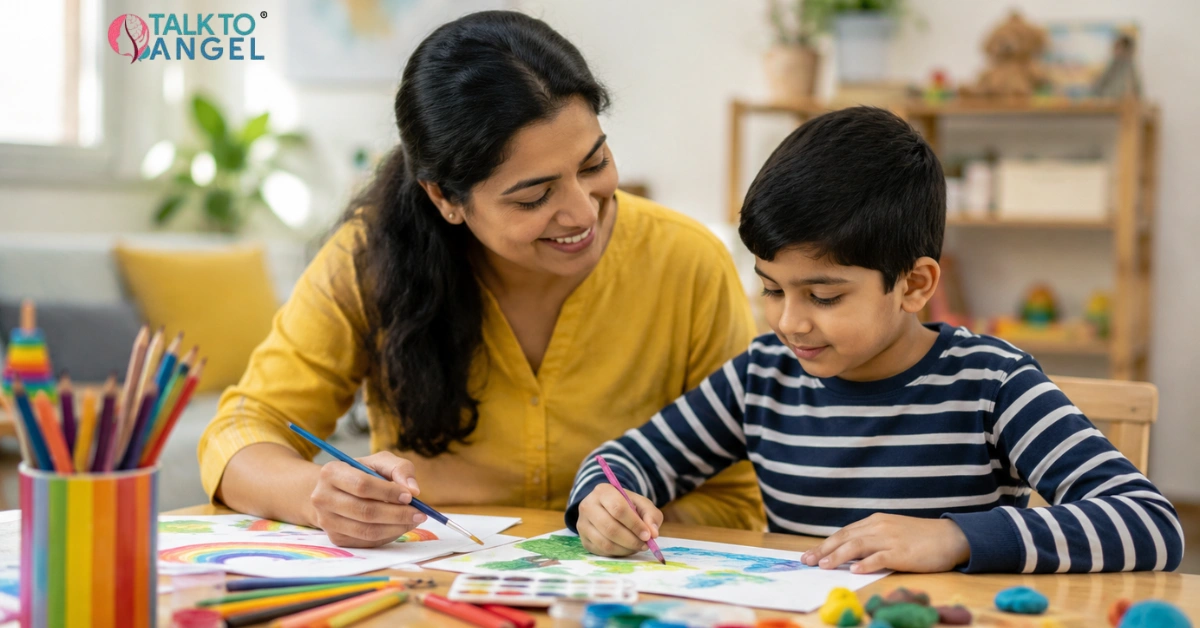
- Shared creative activity – painting alongside a parent builds trust without the pressure of conversation.
- Choice-making – picking colors and tools builds a sense of control and confidence.
Over time, many children begin pairing their art with words, gradually strengthening both verbal and non-verbal communication.
Can Art Therapy Reduce Meltdowns and Anxiety in Autistic Children?
Yes — this is one of the most valued benefits of therapeutic art. Repetitive, hands-on activities like drawing or molding clay have a naturally regulating effect on the nervous system. If you’d like to understand this mind-body connection in more depth, our earlier post on How Art Therapy Unlocks Your Emotions explores exactly how creative expression helps process feelings that are otherwise hard to put into words.
Here’s why art therapy techniques for autism work so well for emotional regulation:
- Predictable routines (same materials, same structure) reduce anxiety from uncertainty.
- Sensory-friendly materials can be customized — textured clay for some, smooth watercolors for others.
- A calm, judgment-free space lets children process feelings before they escalate.
- Rhythmic movements, like repeated brushstrokes, have an almost meditative effect.
Instead of reacting after a meltdown, art therapy helps children build internal tools to recognize and manage overwhelm before it boils over.
What Are the Key Benefits of Art Therapy for Autism?
The benefits of art therapy for autism go far beyond the canvas:
| Area of Growth | How Art Therapy Helps |
|---|---|
| Emotional expression | Safe outlet for feelings hard to verbalize |
| Social skills | Encourages turn-taking and parallel play |
| Sensory regulation | Uses textures, colors, movement to calm the nervous system |
| Self-esteem | Builds confidence through self-expression |
| Fine motor skills | Strengthens hand-eye coordination |
| Parent-child bonding | Creates shared, pressure-free connection |
For many families, these small wins add up to a child who feels understood — and a parent who finally feels like they’re reaching their child.
How Is Art Therapy Different from Occupational or Speech Therapy?
- Speech therapy focuses on verbal communication and language development.
- Occupational therapy targets motor skills and daily living tasks.
- Art therapy focuses on emotional and psychological expression through creativity.
Many children benefit from all three together. A more emotionally regulated child, thanks to art therapy, often engages better in speech or occupational sessions too.
What Signs Indicate Your Autistic Child May Benefit from Therapy?
Watch for these signs:
- Frequent meltdowns or shutdowns that feel hard to predict
- Difficulty expressing even simple emotions in words
- Increasing withdrawal from family activities
- High anxiety around transitions or new environments
- A natural pull toward drawing, coloring, or hands-on creative play
If these sound familiar, it may be worth exploring online counseling for autism in India by connecting with a qualified art therapist.
How Can TalkToAngel Help You Connect with Your Autistic Child?
TalkToAngel’s art therapy programs are designed by experienced child psychologists who understand the emotional and sensory needs of children on the spectrum. Sessions are personalized and judgment-free, structured around your child’s comfort — from simple color exploration to more expressive projects.
With TalkToAngel, you get:
- Access to licensed, experienced child psychologists and art therapists
- Flexible online counseling from the comfort of your home
- A confidential, supportive space for both children and parents
- Guidance on mental health support for children that extends into daily life
You don’t have to navigate this journey alone, and you don’t need all the answers today. Sometimes the smallest step — a shared drawing, a quiet afternoon with crayons — becomes the beginning of a deeper connection.
Ready to take that first step? Book a child psychologist online with TalkToAngel today and discover how art therapy can help you and your child connect in a whole new way.