
Your best performer just missed their third deadline this month. Your most reliable manager snapped at a client call. Sick leave requests are piling up, and nobody can quite say why. This is what employee burnout looks like before it has a name — and by the time it does, it’s already expensive. The good news is that workplace burnout prevention doesn’t have to be reactive. Employee Assistance Programs (EAPs) give organisations a structured, confidential way to catch burnout early and support employees before performance, health, or retention take the hit.
What Is Employee Burnout and Why Should Employers Care?
Burnout isn’t just “feeling tired.” The World Health Organization classifies it as an occupational phenomenon resulting from chronic workplace stress that hasn’t been successfully managed. It shows up as emotional exhaustion, cynicism toward one’s job, and a measurable drop in professional efficacy.
Employers should care because burnout rarely stays contained to one person. It spreads through teams, erodes trust in leadership, and quietly reshapes company culture. A burned-out employee today is often a resignation, a long-term sick leave, or a costly error tomorrow. This is why how to prevent employee burnout at work has become one of the most searched workplace mental health questions among HR leaders.
What Are the Early Signs of Burnout in Your Team?
Burnout builds gradually, which is exactly why it’s so easy to miss. Watch for these patterns:
- Declining engagement — less input in meetings, disengagement from team discussions
- Increased absenteeism or last-minute sick days
- Irritability or cynicism that wasn’t there before
- Falling output quality despite long hours
- Physical complaints like headaches, fatigue, or frequent illness
- Withdrawal from colleagues and informal workplace interactions
Individually, any one of these could mean nothing. Together, and sustained over weeks, they’re a signal worth acting on. Learning to recognise signs of burnout in employees early is often the difference between a quick recovery and a prolonged mental health crisis.
How Much Is Employee Burnout Really Costing Your Business?
The cost of employee burnout is easy to underestimate because it hides across several budget lines rather than appearing as one obvious expense.
Consider the compounding effect:
- Lost productivity from disengaged, under-functioning employees
- Higher turnover, with the cost of replacing a skilled employee often running to several months’ salary
- Increased absenteeism and healthcare utilisation, including stress-related physical illness
- Lower quality of work, leading to rework, errors, and client dissatisfaction
- Erosion of institutional knowledge when experienced staff leave
Global studies have repeatedly placed burnout-related losses at billions of dollars annually across economies — a cost most companies are paying without a corresponding line item to track it. Understanding the financial impact of workplace stress on businesses is often what finally gets burnout prevention onto the leadership agenda.
What Is an Employee Assistance Program (EAP)?
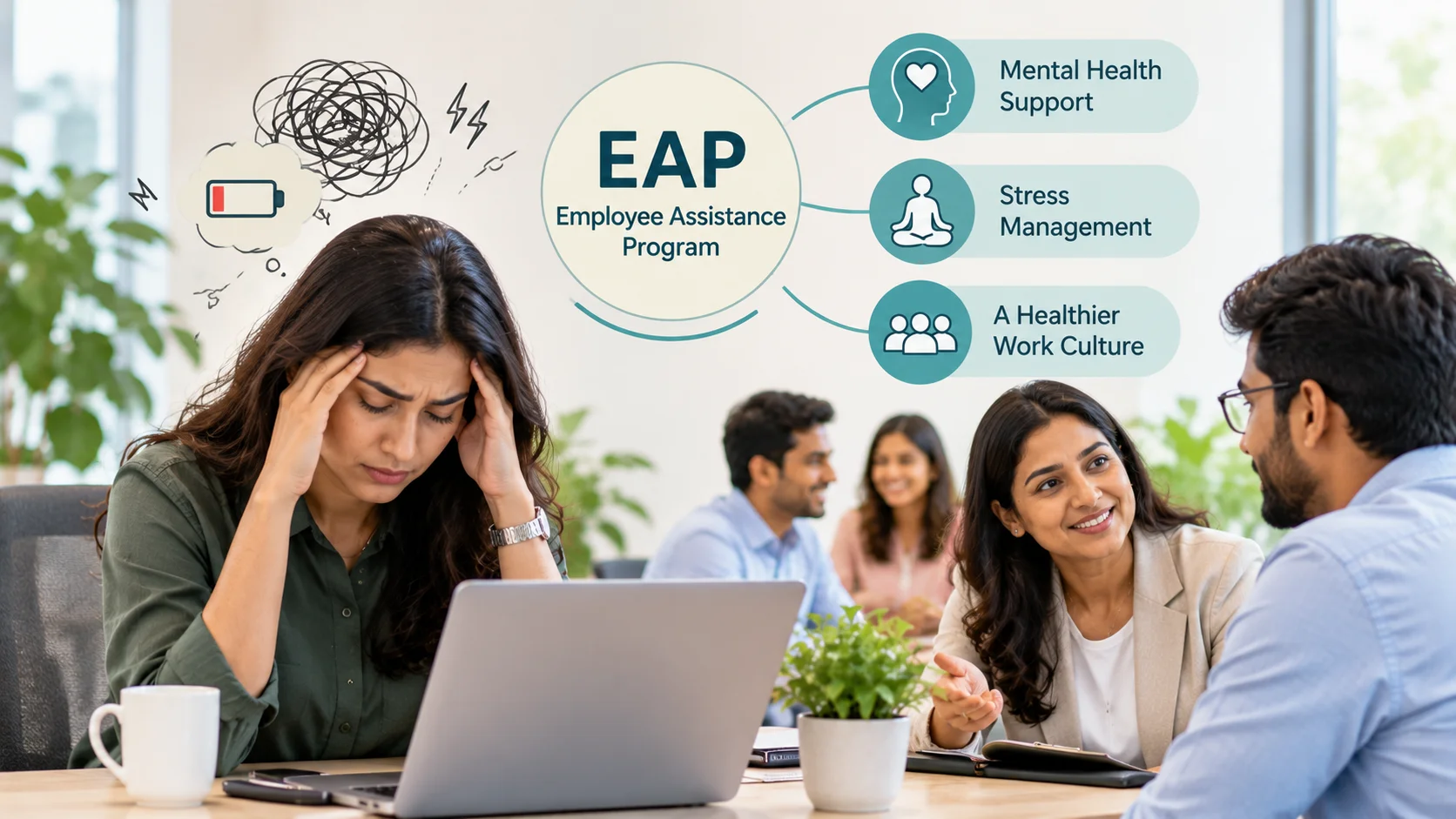
An Employee Assistance Program (EAP) is a workplace-sponsored benefit that provides employees — and often their immediate family — confidential access to professional support for personal and work-related challenges. This typically includes counselling, mental health support, and sometimes financial or legal guidance, made available at no direct cost to the employee.
Think of an EAP as a bridge between an employee’s struggle and the professional help that can address it, built directly into their employment benefits rather than left for them to find on their own.
How Do EAPs Help Prevent and Manage Burnout?
EAP for employee wellbeing works because it intervenes before a crisis forces the issue. Here’s how:
- Early access to counselling means employees can address stress before it becomes chronic
- Reduced stigma around seeking help, since the service is a normalised workplace benefit
- Manager training, helping leaders recognise and respond to burnout signs appropriately
- Confidential support, which encourages employees to be honest about what they’re experiencing
- Preventive resources like stress-management workshops, not just crisis response
Rather than waiting for burnout to force a resignation or a medical leave, EAPs create an accessible off-ramp long before things reach that point. For employees quietly searching for how to deal with work-related stress and anxiety, an EAP is often the first real, professional point of contact.
What Services Do EAPs Typically Offer Employees?
EAP counselling services generally extend well beyond a single hotline. A comprehensive employee assistance program typically includes:
- Short-term counselling for stress, anxiety, depression, and burnout
- Crisis intervention for acute mental health emergencies
- Work-life balance coaching, covering time management and boundary-setting
- Financial and legal consultation for non-clinical stressors that still affect wellbeing
- Referral networks to specialists for ongoing or complex care
- Manager consultation lines for handling sensitive employee situations
The breadth matters. Burnout rarely has a single cause, so support that only addresses one dimension — say, productivity tips without emotional support — tends to fall short. This is also why confidential counselling for employees tends to have far higher engagement than generic wellness webinars or one-off workshops.
How Can Managers Spot and Respond to Burnout Early?
Managers are usually the first line of defence, even when they’re not trained clinicians. A few practical steps help:
Watch for Behavioural Shifts, Not Just Output
A drop in enthusiasm or participation often precedes a drop in performance. Catching the former gives you more runway.
Have Direct, Non-Judgmental Conversations
Simply asking “How are you really doing?” and listening without rushing to fix things can surface issues early.
Know the Referral Pathway
Managers don’t need to solve burnout themselves — they need to know how to point an employee toward the EAP quickly and without friction.
Model Healthy Boundaries
Leaders who visibly take breaks, use leave, and avoid after-hours messaging permit employees to do the same.
Managers who understand how to support an employee with mental health issues without overstepping clinical boundaries create teams that feel safer raising concerns before they escalate.
Why Should Companies Invest in Mental Health Support?
Workplace mental health support isn’t a soft perk — it’s a measurable business decision. Companies that invest in it typically see:
- Lower turnover and recruitment costs
- Reduced absenteeism
- Higher employee engagement scores
- Stronger employer brand and candidate attraction
- Fewer long-term disability claims tied to mental health
Every rupee spent on prevention tends to offset a larger, less predictable cost down the line — whether that’s a resignation, a prolonged leave, or a decline in team performance that’s harder to trace back to its root cause. Companies researching best mental health benefits for employees in India consistently find EAPs near the top of the list for cost-to-impact ratio.
How Confidential Are EAP Services for Employees?
Confidentiality is the single biggest factor in whether employees actually use an EAP. Reputable EAP counselling services operate independently of HR and management, meaning individual session content, diagnoses, or disclosures are never shared with the employer. Employers typically only receive aggregated, anonymised usage data — useful for measuring engagement, never for identifying individuals.
This separation matters because employees who fear professional consequences for seeking help simply won’t seek it. Clear, repeated communication about confidentiality is what turns an EAP from an unused benefit into a trusted resource. Employees often want reassurance that EAP counselling is confidential from my employer before they’ll book a single session.
How Do You Introduce an EAP Without Stigma?
Rolling out an EAP well is as important as having one. A few things help it land:
- Frame it as proactive, not just for crises — positioned for everyday stress, not only breakdowns
- Get leadership buy-in visible, with managers openly referencing the EAP as a normal resource
- Communicate confidentiality clearly and often, not just in the onboarding packet
- Use multiple channels — emails, posters, team meetings — rather than a one-time announcement
- Share (anonymised) impact stories to normalise usage over time
An EAP that’s mentioned once during onboarding and never again will quietly go unused. Repetition and visible endorsement from leadership are what build trust. Normalising conversations around reducing stigma around mental health at work is just as important as the service itself.
How Can You Measure the ROI of an EAP?
Measuring corporate wellness programs can feel abstract, but there are concrete metrics to track:
- Utilisation rate — how many eligible employees are actually using the service
- Absenteeism trends before and after EAP rollout
- Turnover rate changes, especially in high-burnout departments
- Employee satisfaction and engagement survey scores
- Reduction in short-term disability or stress-related leave claims
Most EAP providers can supply aggregated utilisation and outcome data, which HR can then correlate against broader workforce metrics to build a genuine business case.
How Can HR Build a Burnout-Resistant Workplace Culture?
An EAP works best as part of a wider workplace stress management strategy, not as a standalone fix. HR teams can reinforce this by:
- Auditing workloads regularly, not just during annual reviews
- Encouraging actual use of paid leave, rather than letting it accumulate unused
- Training managers specifically on early burnout recognition
- Building psychological safety so employees can raise concerns without fear
- Reviewing policies that unintentionally reward overwork, like glorifying late-night emails
Culture change takes longer than a policy rollout, but it’s what determines whether an EAP gets used — or quietly ignored. Organisations building a burnout-free workplace culture through EAP tend to treat it as an ongoing culture investment rather than a one-time HR checkbox.
How Do You Choose the Right EAP Provider for Your Company?
Before you get started with EAP for your company, evaluate providers against a few essentials:
- Range of services — counselling, crisis support, financial/legal guidance, manager consultation
- Accessibility — multiple contact channels, extended hours, multilingual support if needed
- Confidentiality safeguards — clear data-separation policies from HR
- Qualified professionals — licensed counsellors and therapists, not generic coaches
- Reporting capability — meaningful, anonymised usage data for ROI tracking
- Cultural fit — understanding of your industry’s specific stressors
A mismatched provider — one with limited hours, a narrow service scope, or unclear confidentiality practices — can undermine employee trust before the program even gets off the ground. HR teams comparing top EAP providers for corporate mental health support should ask for case studies or usage data from similarly sized organisations before signing on.
Final Thoughts: Don’t Wait for Burnout to Become a Crisis
Employee burnout rarely announces itself loudly — it builds quietly through missed signals, rising absenteeism, and talent walking out the door. A well-implemented employee assistance program gives your organisation a structured way to intervene early, protect employee wellbeing, and reduce costs long before burnout forces an expensive outcome.
TalktoAngel, a trusted EAP services provider, works with organisations to build confidential, accessible mental health support that fits real workplace needs. If your team is showing early signs of burnout, now is the time to explore how an EAP can help — reach out to TalktoAngel to get started.