
Why Is My Child So Sensitive to Noise, Textures, or Light? A Guide to Sensory Processing Disorder
Does your child cover their ears at birthday parties, refuse to wear certain clothes, or melt down under bright lights? Many parents notice these moments and quietly wonder if something more is going on. You’re not overreacting, and you’re not alone. This guide explains sensory processing disorder in children in plain language — why it happens, what it looks like day to day, and what sensory processing disorder treatment actually looks like in practice.
Why Is My Child So Sensitive to Noise, Textures, or Light?
If your child reacts strongly to everyday sounds, fabrics, or bright lighting, it’s usually not a phase or a personality quirk — it’s often how their nervous system processes sensory input. Their brain may register ordinary sensations, like a doorbell ringing or a scratchy sweater, as far more intense than they actually are. This heightened response is one of the clearest early signs of sensory processing disorder in children, and understanding it is the first step toward helping your child feel more comfortable in their daily environment.
What Is Sensory Processing Disorder and How Does It Affect Children?
Sensory processing disorder (SPD) occurs when a child’s brain struggles to receive, organize, and respond to information coming through the senses — sound, touch, sight, taste, smell, movement, and body awareness.
In most children, this input gets filtered automatically without any conscious effort. For a child with sensory issues, that filter doesn’t work smoothly. A school bell can feel like a siren. A cotton tag on a shirt can feel unbearable.
This isn’t a matter of a child being fussy or overdramatic. Their nervous system genuinely experiences everyday input more intensely, and that shapes their behavior, focus, and relationships.
Children generally fall into one or more of these patterns:
- Over-responsive – strong reactions to input others barely notice
- Under-responsive – seems unaware of input, needs more stimulation to register it
- Sensory seeking – constantly touches objects, crashes into things, craves movement
What Are the Common Signs of Sensory Processing Disorder in Children?
Signs differ depending on age and which senses are affected, but parents often notice a recurring cluster:
- Covering ears in loud places like malls, assemblies, or classrooms
- Refusing specific fabrics, tags, or clothing seams
- Strong reactions to bright light or certain lighting types
- Picky eating driven by texture rather than taste
- Avoiding messy play like sand, paint, or glue
- Poor balance or frequent clumsiness
- Meltdowns that seem disproportionate to the trigger
- An ongoing need to touch surfaces, people, or objects
One or two of these on their own aren’t unusual. A consistent daily pattern that disrupts routines, however, is worth a closer look.
Why Does My Child Cover Their Ears or Avoid Loud Noises?
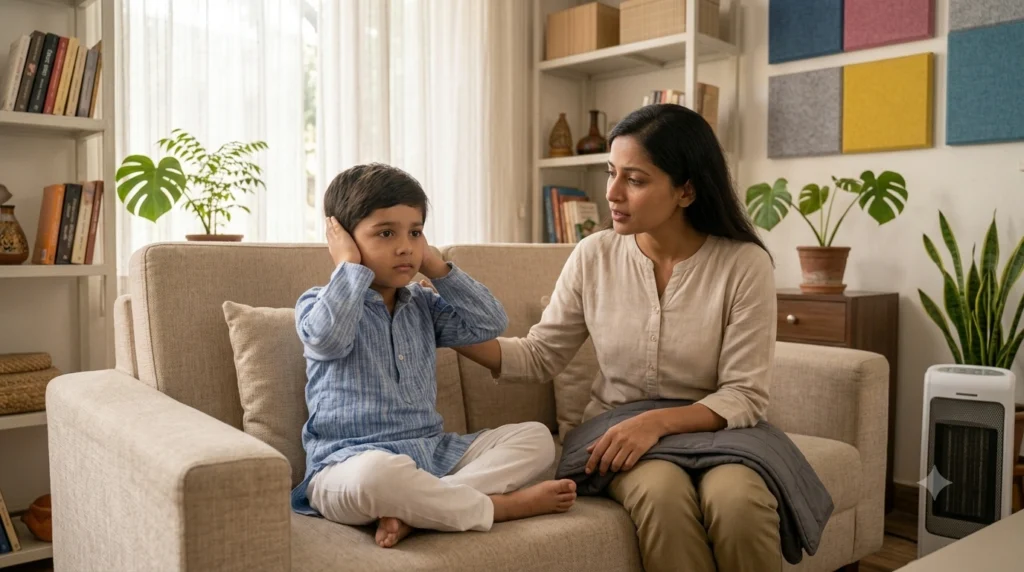
This is one of the questions parents ask most, and it comes down to heightened auditory sensitivity. For a child sensitive to noise, ordinary sounds — a vacuum, a hand dryer, a noisy hallway — can feel physically overwhelming rather than mildly annoying.
Covering their ears is a coping strategy, not defiance. It’s their nervous system trying to reduce input it can’t otherwise regulate on its own.
The same principle applies to other senses:
- A child sensitive to textures may feel genuine discomfort, not pickiness, with certain fabrics or foods
- A child sensitive to light may experience glare, flicker, or brightness far more intensely than others, leading to squinting, headaches, or avoidance of certain rooms
Reframing these reactions as sensory, not behavioral, changes how parents can respond — with support instead of frustration.
Can Sensory Processing Disorder Affect a Child’s Behaviour and Emotions?
Yes, and this is often the first thing parents notice, even before connecting it back to sensory triggers. Managing constant sensory discomfort can show up as:
- Frequent meltdowns or emotional shutdowns
- Anxiety in new or unpredictable settings
- Trouble focusing at school
- Social withdrawal or difficulty making friends
- Low frustration tolerance over small things
Picture it like carrying a backpack that gets heavier throughout the day. By the time a minor trigger hits — a scratchy label, a noisy classroom — the child has little coping capacity left, so the reaction looks much bigger than the trigger itself.
This is exactly why early support matters. Addressing the sensory root often reduces the emotional and behavioral symptoms that first worried parents.
Can Occupational Therapy Help Children With Sensory Processing Issues?
Yes. Occupational therapy for sensory processing disorder is currently the most well-supported approach available. An occupational therapist assesses how a child responds to different types of sensory input and builds a personalized plan around it.
Sensory processing disorder treatment typically includes:
- Sensory integration therapy — guided play activities like swinging, climbing, or textured materials that help the brain organize input more effectively
- Environmental adjustments — noise-cancelling headphones, softer lighting, tag-free clothing
- Regulation strategies — deep pressure activities, movement breaks, weighted blankets
- Parent coaching — simple home strategies so progress continues between sessions
Consistency tends to matter more than intensity. Short, regular sessions paired with home practice usually outperform occasional long ones.
Is Sensory Sensitivity a Sign of Autism or ADHD?
This question comes up often, and it’s a fair one. Sensory sensitivities frequently overlap with autism and ADHD, but sensory processing disorder can also exist entirely on its own.
- Autism: sensory sensitivities are usually one part of a wider pattern that includes social communication differences and repetitive behaviors
- ADHD: sensory-seeking behavior like fidgeting or a need for movement can overlap with attention regulation challenges
- Standalone SPD: sensory symptoms exist without the broader social, communication, or attention patterns seen in autism or ADHD
Only a qualified professional can make this distinction through a proper evaluation. Relying on online checklists alone can cause unnecessary worry — or miss support a child actually needs.
When Should Parents Seek Professional Help?
Trust your instincts as a parent. It’s worth reaching out to a professional if:
- Sensory reactions disrupt daily routines like eating, dressing, or sleeping
- Meltdowns are frequent, intense, or hard to predict
- Your child avoids school, playdates, or activities due to sensory discomfort
- Sensory signs appear alongside developmental or communication delays
- The behavior is affecting your child’s confidence or friendships
An online psychiatrist for sensory processing disorder can assess whether these symptoms connect to a broader condition, rule out other explanations, and coordinate care with an occupational therapist for a well-rounded plan. Early evaluation doesn’t label your child — it simply helps you understand and support them sooner.
TalktoAngel: A Trusted Platform for Your Child’s Mental Health
If these patterns sound familiar, you don’t have to navigate them alone. TalktoAngel connects parents with licensed psychiatrists and psychologists experienced in childhood sensory and developmental concerns, from the comfort of home. If you’d like to explore this topic further, our detailed guide on Sensory Processing Disorder: Causes and Support Strategies breaks down the underlying causes and practical coping strategies in more depth.
Getting clarity early can change how your child experiences school, friendships, and everyday life. Book a psychiatrist consultation online with TalktoAngel today and take the first step toward understanding your child’s unique way of experiencing the world.
Frequently Asked Questions
What is the main cause of sensory processing disorder in children?
There’s no single known cause. Research points to differences in how the brain’s nervous system organizes sensory signals, often influenced by genetics and early neurological development. It’s not caused by parenting style or a specific event.
How is sensory processing disorder diagnosed?
There’s no blood test or scan for sensory processing disorder. Diagnosis usually involves an occupational therapist or psychologist observing the child, using structured assessments, and gathering detailed input from parents about daily behavior patterns across different environments.
Can sensory processing disorder improve with age?
Many children improve significantly with early intervention, especially occupational therapy and consistent home strategies. While some sensitivities may persist into adulthood, most children learn effective coping tools that reduce daily disruption over time.