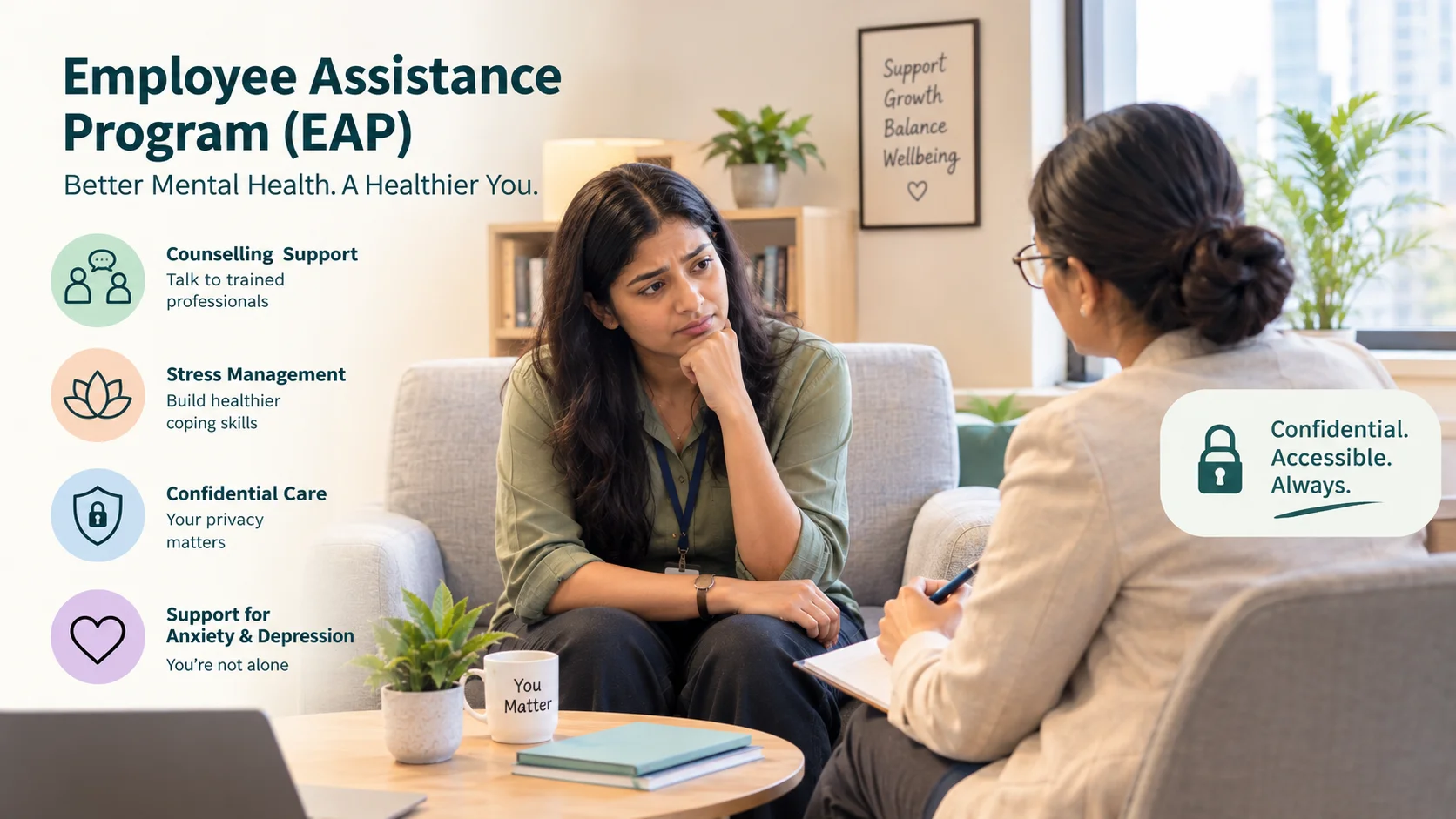
Mental health struggles don’t stay neatly contained outside office hours. Anxiety and depression often follow employees into meetings, deadlines, and daily decision-making, quietly chipping away at focus and energy. This is where an Employee Assistance Program (EAP) becomes a lifeline. An EAP offers confidential counselling, crisis support, and practical resources designed to help employees manage anxiety and depression at work before these challenges spiral into burnout or job loss. If you’re an HR leader, manager, or employee wondering how this support system actually works, this guide breaks it all down.
What Is an Employee Assistance Program (EAP) and How Does It Work?
An Employee Assistance Program (EAP) is a workplace-sponsored benefit that gives employees free, confidential access to professional counselling and support services. Most EAPs are run by external providers, which means the company doesn’t see who is using the service or why.
Typically, an EAP works like this:
- Employees reach out via a dedicated helpline, app, or online portal.
- They’re connected with a licensed counsellor or therapist, often within 24–48 hours.
- Sessions can happen over phone, video, or in person, depending on the provider.
- Most programs offer a set number of free sessions (commonly 4–8) before referring the employee to longer-term care if needed.
This structure makes EAP for mental health at work one of the fastest, least bureaucratic ways for someone to get help without navigating insurance paperwork first.
How Can an EAP Help Employees Manage Anxiety at Work?
Anxiety at work can show up as racing thoughts before a presentation, constant second-guessing of emails, or a tight chest during performance reviews. An Employee Assistance Program for anxiety and depression addresses this through structured, evidence-based support.
Short-Term, Solution-Focused Therapy
Most EAPs use short-term solution-focused therapy, which targets immediate stressors rather than digging into years of history. This approach helps employees build coping strategies quickly — often within a handful of sessions.
Practical Stress Management Techniques
Counsellors frequently teach stress management techniques such as:
- Breathing exercises for acute anxiety spikes
- Time-blocking to reduce overwhelm
- Boundary-setting scripts for difficult conversations
- Grounding techniques for panic moments before meetings
Access to Cognitive Behavioral Therapy (CBT)
Many EAP providers offer cognitive behavioral therapy (CBT), a well-researched method for reframing anxious thought patterns. CBT helps employees identify distorted thinking (“I’m going to get fired for this one mistake”) and replace it with balanced, realistic perspectives.
Can an EAP Support Employees Dealing with Depression?
Yes — EAPs are equally equipped to support depression, though the approach looks a little different. Depression often shows up as low motivation, difficulty concentrating, and withdrawal from colleagues, which can be harder to spot than anxiety.
EAP counsellors are trained to:
- Screen for depression severity and risk factors
- Provide immediate coping strategies for low-energy days
- Refer employees to psychiatrists for medication evaluation when necessary
- Offer follow-up check-ins to track progress
For employees who feel isolated, simply having a confidential space to talk — without worrying about judgment from a manager — can be the first step toward recovery.
What Mental Health Services Do EAPs Typically Offer?
EAP services for employees usually go beyond basic counselling. A comprehensive workplace mental health support program often includes:
- Individual counselling for anxiety, depression, grief, and relationship issues
- Crisis intervention for acute mental health emergencies
- Manager consultations to help supervisors handle sensitive conversations
- Work-life balance support, including resources for childcare, eldercare, and financial stress
- Substance use support and referrals
- Legal and financial counselling for non-clinical stressors that affect mental health
This breadth matters because anxiety and depression rarely exist in isolation — they’re often tangled up with money worries, family conflict, or health concerns.
Is EAP Counseling Really Confidential?
This is one of the most common — and important — questions employees ask. In most reputable EAPs, yes, counselling is genuinely confidential.
Here’s what that typically means in practice:
- The employer only receives aggregated, anonymous usage data (e.g., “120 employees used the EAP this quarter”).
- Individual session content, diagnoses, and attendance are never shared with HR or managers.
- Exceptions exist only in cases of imminent harm to self or others, which is standard across licensed mental health practice.
If confidentiality is a concern, employees should ask HR directly for the provider’s privacy policy before their first session — transparency here builds trust in the program.
How Does an EAP Reduce Workplace Stress and Burnout?
Workplace burnout doesn’t happen overnight — it builds through chronic stress, lack of support, and poor psychological safety at work. EAPs intervene at multiple points in this cycle.
Early Intervention Before Crisis Point
Because EAPs are easy to access and free, employees often use them before a problem becomes severe, rather than waiting until they’re in crisis.
Manager Training and Support
Many EAPs train managers to recognize early warning signs and refer employees appropriately, improving occupational mental health across entire teams.
Reducing Presenteeism and Absenteeism
By addressing issues early, EAPs directly reduce presenteeism (being at work but mentally checked out) and absenteeism and productivity loss tied to untreated mental health conditions.
What Are the Signs an Employee May Need EAP Support?
Managers and colleagues aren’t expected to diagnose anyone, but recognizing these patterns can prompt a gentle nudge toward support:
- Noticeable drop in work quality or missed deadlines
- Increased irritability or withdrawal from team interactions
- Frequent unexplained absences
- Visible fatigue or difficulty concentrating
- Expressions of hopelessness or feeling “stuck”
If you notice these signs in yourself or a colleague, mentioning the EAP casually — “Hey, have you checked out our EAP? I’ve heard it’s genuinely helpful” — can lower the barrier to seeking help.
How Do Employees Access EAP Mental Health Services?
Access usually involves three simple steps:
- Find the contact details — typically shared via HR onboarding materials, the company intranet, or a benefits portal.
- Reach out confidentially — through a phone line, app, or website, without needing manager approval.
- Schedule the first session — most providers offer appointments within a few days, sometimes same-day for urgent needs.
No referral from a doctor or manager is required in most EAP models, which is part of what makes this benefit so accessible.
Why Should Employers Invest in an EAP Program?
From a business standpoint, employee wellbeing programs like EAPs aren’t just a compassionate gesture — they’re a measurable investment. Organizations with strong HR mental health policy frameworks tend to see:
- Lower turnover and recruitment costs
- Fewer sick days tied to stress-related illness
- Improved team morale and retention
- Stronger employer branding in a competitive job market
Employers who normalize mental health conversations — rather than treating them as taboo — also see reduced stigma, which encourages more employees to actually use the benefit.
How Effective Are EAPs in Improving Employee Productivity?
Research consistently shows that untreated anxiety and depression cost organizations significantly more in lost productivity than the cost of running an EAP. When employees receive timely support:
- Concentration and task completion improve
- Conflict within teams decreases
- Sick leave linked to mental health concerns drops
- Overall engagement scores rise
The return on investment isn’t just financial — it’s cultural. Teams where people feel supported tend to collaborate better and recover faster from setbacks.
What Are Common Barriers to Using an EAP — and How to Overcome Them?
Even well-designed EAPs go underused because of a few recurring obstacles:
| Barrier | How to Overcome It |
| Fear of confidentiality breaches | Share clear, written privacy policies during onboarding |
| Lack of awareness that the EAP exists | Promote it through regular reminders, not just one-time onboarding |
| Stigma around seeking help | Normalize usage through leadership openly endorsing the program |
| Confusing access process | Simplify sign-up to a single click or call |
Addressing these barriers directly — rather than assuming awareness equals usage — is what separates a well-utilized EAP from an underused one.
TalktoAngel: One of the Best EAP Providers for Mental Health in India
For organizations in India looking to implement a reliable workplace mental health support program, TalktoAngel stands out as one of the best EAP providers for mental health in India. With a network of licensed psychologists and counsellors, TalktoAngel offers confidential, accessible therapy tailored to workplace stress, anxiety, and depression — helping both employees and employers build a psychologically safer work environment.
Final Thoughts: Taking the First Step Toward Support
Anxiety and depression at work are more common than most people realize, but they don’t have to be managed alone. An EAP offers a confidential, low-barrier way to access professional support — whether that’s a single conversation during a hard week or ongoing therapy for a longer struggle. If your workplace offers an EAP, consider reaching out today; and if it doesn’t, it may be worth advocating for one. Taking that first step often feels like the hardest part — but it’s also the one that changes everything.
Ready to explore professional support? Connect with a licensed counsellor through TalktoAngel and take the first step toward better mental health at work.